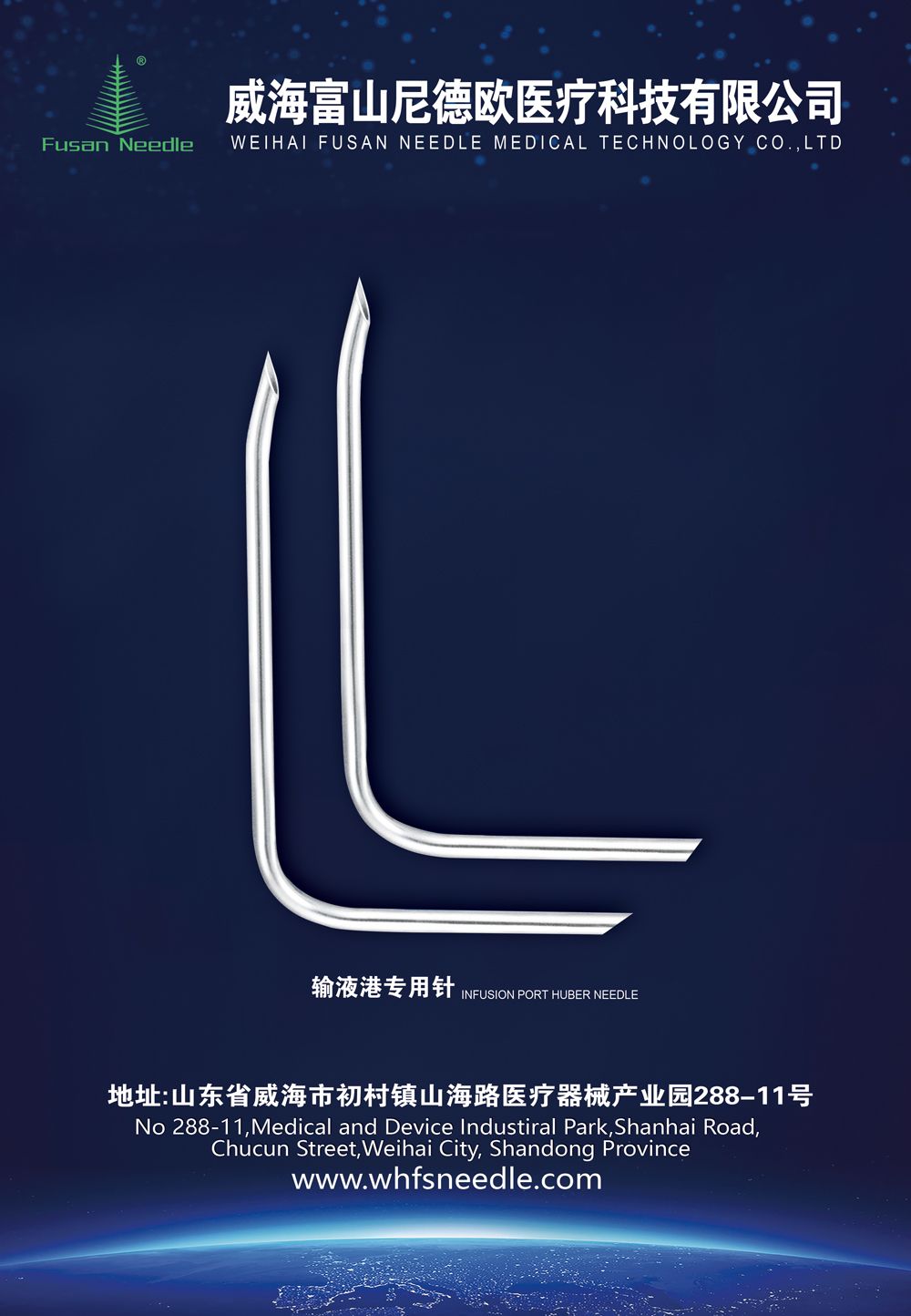
Non-Damage Needle in Infusion Port Care
The non-damage needle was invented before the IV infusion port and was first used in hepatic artery pumps. Its key feature is the tip design: during puncture it does not cut the port's septum, preventing septum damage, leakage and particle clogging of the catheter and vessel.
The Huber needle is named after its inventor Ralph L. Huber, an inquiring dentist who in 1946 invented the needle to reduce tissue damage and pain during dental anesthesia. Huber never published a paper; 36 years later the needle was found to be ideal for IV ports. The non-damage needle tip has a deflection point that avoids the coring effect of ordinary needles.
Non-damage needles come in different shapes, lengths, diameters and bevel designs: straight and 90°; length 12-37mm; gauge 19-22G; high-pressure and standard; safety and non-safety types.
Selection: choose by patient body type, port height, subcutaneous position, flow rate and drug viscosity. General drug infusion: 22G; blood or blood products: 19-20G; thin patients: 1.6cm length; obese patients: 2.5cm length.